Showing posts with label DNA. Show all posts

2013-04-26

DNA double helix: 60 years of sexism in science

(also at Pulling on the corkscrew of life)

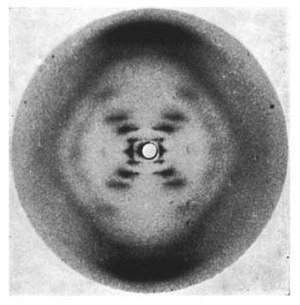
Picture 51

Rosalind Franklin 1920-1958

Sixty years ago today, on 25 April 1953, Francis Crick and James Watson published a paper in Nature describing the double helix structure of DNA.

There have been a flurry of excellent articles in the newspapers to commemorate this auspicious anniversary and, (especially) if you are at all unfamiliar with the history and significance of Crick and Watson's discovery, I wholeheartedly recommend Adam Rutherford's piece in today's Guardian.

Adam also relates some details of Rosalind Franklin's story and the way she was belittled by her male colleagues. Franklin's contribution to the unravelling of the structure of DNA was, to some extent, written out of history - a wrong which has only been righted in relatively recent times - and a number of commentators have sought to rescue her reputation (as they see it), set the record straight, and put Rosalind Franklin's name up there where it belongs alongside Watson's and Crick's. (see for example Anne Sayre and Lynne Osman Elkin)

This is not, however, quite the simple female-goody versus male-baddies tale that some modern accounts suggest. Real stories rarely fit tidy narratives.

Part of the reason Rosalind Franklin was "written out of history" is simply the fact that she died tragically young and Nobel Prizes are never awarded posthumously. Of course whether she would have received the Prize if she had lived is impossible to say, but even Jim Watson is on record as saying that she should have done. The famous Picture 51 (above) which played a crucial role in the DNA story is often credited to Franklin (see eg wikipedia) and is certainly testament to her skills in this field but it was actually taken[1] by her (male) student Raymond Gosling who (as Adam Rutherford also notes) has been written out of history to an even greater degree than his female supervisor. While Jim Watson is astonishingly patronizing in the pages of The Double Helix : A Personal Account of the Discovery of the Structure of DNA, Francis Crick (as is often noted) is far more generous to Franklin and fully acknowledges the significance of her contribution. He does, however, correctly point out that X-ray crystallography alone could never have revealed the detailed chemical structure of DNA and that the Crick/Watson approach to the problem and Franklin's approach were very much complementary strands (if you'll forgive the pun).

As I say, life is complicated.

But regardless of the complex twists and turns (sorry I can't help myself) of history and science, there is no doubt, however, that Rosalind Franklin was the victim of appalling sexism - and not just from Jim Watson.

Inspired by the various newspaper articles I read today, I dug out my copy of What Mad Pursuit (Crick's autobiographical account of the subject at hand) and reminded myself of one or two things he had to say:

People have discussed the handicap that Rosalind suffered in being both a scientist and a woman. Undoubtedly there were irritating [sic] restrictions - she was not allowed to have coffee in one of the faculty rooms reserved for men only - but these were mainly trivial, or so it seemed to me at the time. (op cit p 68)
Well yes, but though I'm a man, I can kind of imagine that a woman might find something like that a teensy bit more than "trivially irritating".

Crick goes on to say:

Feminists have sometimes tried to make out that Rosalind was an early martyr to their cause, but I do not believe the facts support this interpretation. [...] I don't think Rosalind saw herself as a crusader or a pioneer. I think she just wanted to be treated as a serious scientist. (ibid p 69)
Now perhaps I've got the wrong end of the chromosome here, but I always thought that a world where women can be treated as serious scientists is exactly the sort of thing those dreadful feminists have always been arguing for.

As a younger man, Crick and Watson's work inspired me to go to university and study genetics. It's hard to imagine they inspired many women to do the same. Let us hope that one legacy of the Rosalind Franklin story is that the next sixty years sees many more young women entering science and being taken seriously when they do.


[1] The only reason I know this is again down to the aforementioned Adam Rutherford.

2011-04-19

The not so earnest Adam Rutherford (no relation) on genes rather than physics


There will inevitably be silly comparisons drawn between Brian Cox’s big budget Wonders series and Rutherford’s somewhat lower budget Gene Code, but we should treat all such comments with the contempt they deserve. There’s room in the modern digital schedules for science programmes of every genre and cost from 1970s OU style chalk and talk lectures (though preferably without the big ties) through to the cinematic grandeur of Brian’s efforts [my take on #wonders media coverage].

We should rejoice in all of these attempts to use the medium of television to educate us – while, one also hopes, entertaining us.

While I also love considering the profound questions thrown up by quantum theory, relativity, and cosmology, you have to admit that modern physics is a bit fucking weird. My original background was in genetics and biochemistry (though both sciences have come on a lot since I studied them and I can’t claim to have studied them very hard) and I had been really looking forward to being entertained by Adam’s Rutherford’s series safe in the knowledge that he was not going to come on and open with something like: “Ever since scientists first started looking at chromosomes they have wondered whether chromosomes go on for ever or if the two ends join up again in the 57th dimension”. You know that genes, at least, are something you can try get your brain around without giving yourself a migraine. But that is not to say there’s anything easy about genes. If physics is like an old fashioned library (albeit an old fashioned library stocked with some pretty queer books) genetics is like the internet.

Whether you know a little or a lot about genetics (providing you have a sense of curiosity about the worlds within us and without us) you will enjoy The Gene Code and I urge you to watch it.

Here (if anyone’s interested) is what I took away from the first episode……..

First a bit of basic genetics: The master tape of instructions for what goes on inside our cells is (as most are probably aware) a series of long strands of DNA (AKA “chromosomes”). From these master copies, our cells make lots of RNA copies (a bit like the building contractor keeping the approved drawings safe in a locked draw and making lots of slightly dodgy photocopies to hand round to the builders on site). From these RNA copies of the genetic code, our cells make proteins. Proteins serve two main functions in our bodies: they can be structural (like the proteins that make up our muscles) or regulatory (like the enzymes – which are also proteins – that make things happen inside – and sometimes outside – our cells).

The understanding described above gave rise to Francis Crick’s “central dogma of molecular biology” [see here for eg] which is that (though there are different formulations) “information flows from DNA to RNA to protein”.

Information flow:
DNA -> RNA -> Protein


Now here’s the wonderful thing about science: Almost before the ink was dry on the first statement of this “dogma”, scientists (including Crick himself) begun to make discoveries that (kind of) challenged it. Contrast this with what happens vis-à-vis the central dogmas of any religion or “alternative” medicine one might care to think of.

Proteins (called “polymerases”) can duplicate strands of DNA and RNA, so information can flow from DNA to DNA and from RNA to RNA.

Other proteins (“reverse transcriptases”) can make DNA from RNA – a mechanism used by some viruses such as HIV - so information can flow from RNA to DNA.

With the emergence of “Mad Cow Disease” and the flurry of research into prion proteins that episode prompted, came confirmation (long suspected – arguably from as long ago as the 1930s) that information can flow from protein to protein.

Proteins can also, it has been discovered, bind to chromosomes and “switch” sections of DNA on and off and those switch positions can be inherited. This is not quite information flowing from protein to DNA, but it’s pretty damn close.

What made me sit up straight in my chair watching The Gene Code was Adam Rutherford’s report of recent discoveries concerning a gene that is (or was) responsible for changing the positions of recombination “hotspots” (the points at which, as Adam splendidly demonstrated using only a pack of cards, chromosomes from each parent break and join with one another to swap sequences of DNA) from the positions where those hotspots existed in the human/chimp common ancestor.

It turns out (Thx @AdamRutherford on Twitter) that the gene in question produces a protein that helps to cause DNA mutations that lead to the hotspot position changes. But these are permanent changes to the DNA sequence that are occasioned by the protein product of another gene.

So is this a case of information flowing from protein to DNA? Not sure myself. It’s an essentially philosophical question and I would need to think about it some more. But it’s certainly fascinating – well at least to a nerd like me.

So next time you read that “boffins have discovered the gene for Daily Mail allergy” (or whatever) please bear in mind that it’s almost certainly a bit more complicated than that – and more interesting too.

Oh and watch next week (2011 April 25) at 09:00 pm on BBC4, and let’s have even more science on TV.

[show times for the gene code]